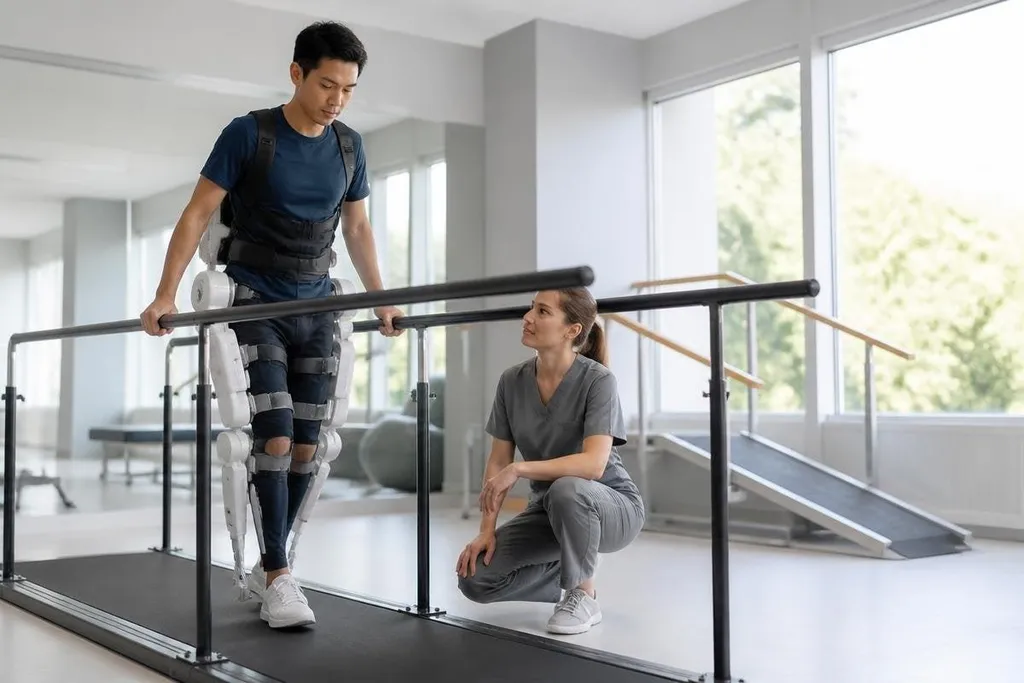
A rehabilitation robot can guide a limb through a set path, support a patient’s weight, or help repeat a task after injury. Its future will depend on a plain question: does the machine help people regain useful movement in daily life?
- Robots can repeat exercises with steady timing and measured force.
- Therapists still need to choose the task, watch the patient, and adjust the plan.
- Wider use depends on proof, cost, safety, and access beyond specialist clinics.
What the robots do
Robot-assisted rehabilitation covers several kinds of machines. An exoskeleton can support the legs or arms while a person walks or reaches. A robotic arm can guide a weak limb through repeated movements. A powered treadmill system can help a patient practise stepping while sensors record each attempt.
The machine changes the work by controlling part of the motion. A therapist can set the path, speed, level of support, or amount of resistance, depending on the system. Sensors then record movement, force, balance, or task completion, giving the care team information to review.
Repetition matters because recovery often depends on practising a movement many times. The system can keep the task steady when a person tires, but steady movement is not the same as useful movement. The exercise still needs to match the patient’s condition and daily goals.
The therapist remains in the loop
A robot does not decide why a patient is struggling. Pain, fear, poor balance, weak muscles, and trouble understanding the task can look similar in a machine’s data. A therapist has to connect that data with the person in front of them.
That role may change as systems collect more movement records. A care team could compare a patient’s current reach with earlier sessions, then adjust support when the person gains control. The value comes from the next treatment choice, not from the chart alone.
I’d judge a rehabilitation robot by the patient’s progress, not by how human its movement looks.
A therapy robot can move a patient’s arm in a clinic, but that motion says little about gains after discharge. Robot24.com rehabilitation coverage can tie each claim to the machine, trial group, task, and care cost before the next section examines what proof is still missing.
Where the proof needs to improve
A useful test should measure more than how many repetitions a person completes during one session. It should also ask whether the person walks farther, uses an arm with less help, manages a home task, or keeps the gain after treatment ends.
That creates a hard measurement problem. A patient may improve because of the robot, the therapist’s work, ordinary recovery, or several treatments used together. Good studies need clear groups, clear tasks, and follow-up after the sessions finish.
The setting matters too. A robot that works well in a clinic may need trained staff, floor space, cleaning steps, and regular servicing.
A home system adds questions about setup, internet access, supervision, and what happens when the device reports a fault.
Cost will shape access. A machine that needs a specialist room and a trained operator may suit a hospital but miss smaller clinics. A lighter system could reach more people, yet it may offer less support or collect less useful data.
Safety and patient control
Safety has two parts. The machine must limit force and stop when it detects a problem. The treatment plan must also give the patient a clear way to pause, ask for help, or refuse a task.
That second part is easy to miss. A person may follow a robot’s movement because the system appears certain, even when the task causes pain or fear. The interface should show what the robot will do, how much help it is giving, and who can change the settings.
Data needs care as well. Movement records can show weakness, balance problems, or changes over time. Clinics need clear rules for storage, access, and deletion, especially when a system sends data outside the treatment site.
A buying and trial checklist
Before a clinic adds a robot-assisted rehabilitation system, its team should check:
- Patient task: Does the machine practise a movement that matters outside the clinic?
- Staff time: Who sets the session, watches it, cleans the equipment, and handles faults?
- Measured result: Which result will count as progress, and when will staff check it again?
- Patient control: Can the person pause the task and understand the help level?
- Service plan: What training, repairs, software work, and replacement parts will the clinic need?
- Access: Can the system reach patients who cannot visit a specialist centre often?
These questions keep the purchase tied to care rather than a polished demonstration. They also give clinics a way to compare systems that use different sensors, control methods, and exercise plans.
Robot-assisted rehabilitation has a useful place when it helps a person practise more safely and gives therapists better records. The next step is not a more human-looking machine; it is published proof that gains in the clinic remain useful at home, at work, or during ordinary movement.